Urban Sprawl Act and West Maas en Waal
Why a shelter?
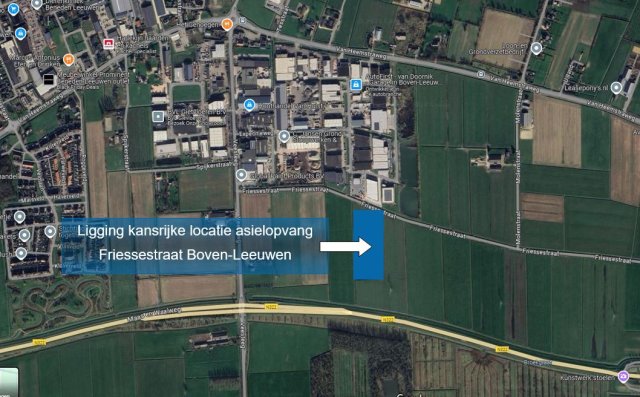
The influx of asylum seekers into the Netherlands remains high, creating a need for more shelter facilities. The government wants these facilities to be distributed fairly among municipalities. That is why a new law took effect on February 1, 2024: the Distribution Act. This law requires municipalities to provide shelter for asylum seekers. The municipality is implementing this law and, to that end, is exploring the opening of a single asylum shelter for 150 to 180 asylum seekers on Friessestraat in Boven-Leeuwen.
Why is the lot on Friessestraat in Boven-Leeuwen ?
On December 16, 2024, an information session was held regarding the designation of a potential refugee shelter. During the event, interested parties received information about the plans. Representatives from the COA were also present to answer questions. The choice of location was not up for discussion during this meeting.
Asylum Seeker Inflows and the Distribution Act
The influx of asylum seekers into the Netherlands remains high, creating a need for more shelter facilities. The government wants these facilities to be distributed fairly among municipalities. That is why a new law took effect on February 1, 2024: the Distribution Act. This law requires municipalities to provide shelter for asylum seekers.
What does the Spreading Act mean for municipalities?
The Distribution Act ensures a fair distribution of asylum accommodations across provinces and municipalities. Municipalities may collaborate to provide sufficient accommodations.
If efforts to create enough shelter spaces across the entire province prove unsuccessful, the State Secretary may intervene and decide to designate municipalities as mandatory providers. This means that municipalities may be compelled to provide shelter. Creating shelter spaces for asylum seekers is therefore a legal requirement.
What does the Spreading Act mean for West Maas en Waal?
Under the Distribution Act, the municipality West Maas en Waal arrange for 121 shelter places. Of these, 10 are for unaccompanied minor refugees (UMRs).
In September 2024, the municipal council guidelines for the reception of refugees. One of these guidelines is that the COA will organize the reception and will also provide care, language classes, security, and activities. The COA can only organize this effectively if 150 to 180 refugees are accommodated.
The distribution of the 96,000 designated shelter spaces across the provinces and municipalities has been published in the Government Gazette.
Why does West Maas en Waal with other municipalities?
The municipality is collaborating with Maasdriel and Zaltbommel. It has been agreed that unaccompanied minor refugees will be accommodated in another municipality. Even if more Ukrainian refugees need to be accommodated, this will be handled by another municipality. By working together, different priority groups can be exchanged, and clustering can also take place. That is why the number of accommodation spots sometimes differs from the distribution decision. Municipalities are permitted to collaborate with neighboring municipalities to ensure proper accommodation arrangements.
municipal council Members
On August 20, 2024, the executive board established executive board number of guidelines for the accommodation of asylum seekers. These guidelines were discussed by the municipal council on September 12, 2024. Among other things, they address the maximum number of asylum seekers the municipality intends to accommodate, how long it intends to do so, and what it considers important in this regard. These guidelines serve as the basis for the search for suitable accommodation sites.
The municipal council has municipal council the following guidelines:
- The municipality is implementing the Spreading Act and is preparing to establish a reception facility by July 1, 2025.
- The municipality is establishing a single asylum reception facility within its boundaries. Subject to (sub)regional coordination, this will be a standard asylum reception facility with a capacity for 150–180 asylum seekers, located near a village center.
- The municipality is not planning to open temporary emergency shelters, but is focusing on opening a permanent facility.
- The municipality is not invoking the KAN provision. The organization and operation of the asylum reception facility therefore remain the sole responsibility of the COA. Should it become apparent that the COA is unable to provide the necessary services (support, care, language lessons, recreation, security, etc.) prior to or during the actual reception, the municipality will close the reception facility within two months by means of a council resolution.
- The executive board municipal council executive board and keeps residents, business owners, and the municipal council informed throughout the entire process.
- The executive board the site selection process and, within the established framework and process, municipal council a single location to the municipal council . The municipal council final municipal council the proposed location based on its “right to advise.”
- A site is considered suitable if it will be available for at least 5 years and is not part of the current housing supply or development for residents. The maximum term depends on the site assessment, applicable zoning regulations, the results of the public engagement process, and the decision made by the municipal council. In the council proposal regarding the final site, the executive board municipal council executive board defined timeframe to the municipal council .
- If the Distribution Act is repealed or expires, the quota for our municipality will also lapse. The municipal council then decide within 3 months to terminate the reception of refugees, even if the 5-year period has not yet expired.
- Funds received by the municipality under the Spreading Act are allocated in consultation with the municipal council.
Community involvement
The municipality understands that providing shelter for asylum seekers may raise questions and concerns among residents. That is why residents and business owners were involved in the process of finding a suitable and humane shelter location. The first opportunity to have a say was during the roundtable discussion (RTG) on August 27, 2024.
What was the municipality going to do after establishing the guidelines?
The established criteria helped us identify suitable locations. We looked for places that best met those criteria. The public had until October 1, 2024, to submit location suggestions to the municipality.
The municipality assessed the sites based on the guidelines and is evaluating whether they are suitable. The Central Agency for the Reception of Asylum Seekers (COA) was involved in this process. This resulted in a list of potential sites. The executive board the best site and presented it to the municipal council.
The city will hold talks with residents living near the promising site
These meetings take place at the sites themselves or in the surrounding area. Residents can share what matters most to them regarding the establishment of an asylum shelter. The municipality can also learn what factors it needs to take into account.
On December 16, 2024, an informational meeting was held at MFA De Rosmolen.
A number of residents signed up for the sounding board group at that time. As soon as it is definitively clear that it is possible to open Boven-Leeuwen shelter on Friessestraat in Boven-Leeuwen , the municipality will invite this group to an initial meeting.
Participation Process
Following the municipal council positive decision, the project team municipal council the public engagement process.
The schedule and any related documents can be found below:
| Who? | Purpose | When | Information |
|---|---|---|---|
| Executive board | Proposed guidelines for municipal council | August 20, 2024 | List of executive board Decisions, August executive board , 2024 (81 kb) |
| RTG Space | Discuss the executive board 's proposal executive board frameworks | August 27, 2024 | To the RTG room on August 27, 2024 |
| City Council Meeting | Discuss the executive board 's proposal executive board frameworks | September 12, 2024 | For the municipal council meeting municipal council September 12, 2024 |
| Executive board | Discussing municipal input on the provincial plan | October 1, 2024 | Letter from the Core Team on Asylum and Migration - Reception of Refugees under the Distribution Act |
| Provincial Steering Committee | Discuss the draft provincial plan | October 17, 2024 | |
| Executive board | Inform municipal council the final provincial plan | October 29, 2024 | Letter from the King's Commissioner to executive board the Gelderland Asylum Reception Plan |
| Executive board | Information Memorandum on Designating Promising Locations under the Spatial Distribution Act | December 3, 2024 | Information Memorandum on Promising Locations under the Spatial Distribution Act |
| Municipality | Informing residents through an informational evening | December 16, 2024 | |
| Executive board | Information Memo: Progress on the Construction of the Friessestraat Shelter | April 22, 2025 | Information Memo: Progress on the Construction of the Friessestraat Shelter |
| COA | Financial analysis completed | June 11, 2025 | Information Memo: Progress on the Development of the Friessestraat Asylum Shelter |
| COA | Preliminary spatial study completed | 2026 | |
| Executive board | Draft management agreement for the selected location, submitted to municipal council | 2026 | |
| City Council Meeting | Comments and concerns regarding the draft management agreement | 2026 | |
| Executive board | Adoption of the Management Agreement | 2026 | |
| COA | Construction and operation of an asylum shelter | 2026–2027 |