Spatial developments under the Omgevingswet
Introduction
The Omgevingswet on January 1, 2024. The Omgevingswet about a radical change in the spatial planning system. Procedures, laws, and regulations will change, and this will mean significant changes for developers of new spatial projects.
The purpose of this document is to provide project initiators with clarity on how we, as a municipality, view the new practical situation and how we are utilizing the new procedural options to facilitate spatial development under the Omgevingswet.
Introduction to the Omgevingswet
The Omgevingswet that the municipal council must adopt environmental plan municipal council environmental plan the entire territory of the municipality. Among other things, the environmental plan replace the current zoning plans. The environmental plan the municipal regulations governing the physical living environment. The environmental plan the zoning plan (and related spatial plans such as detailed implementation plans, amendment plans, and management ordinances) as well as all other ordinances containing rules regarding the physical living environment, such as sections of the General Local Ordinance (APV) and the Heritage Ordinance.
What will happen when the Omgevingswet takes effect?
On January 1, we will environmental plan receive an environmental plan under transitional law; this is known as environmental plan temporary environmental plan. The temporary environmental plan of:
- the existing land-use plans in our municipality (zoning plans, amendment plans, implementation plans, and management regulations);
- a number of ordinances (the (archaeology provision of the) Heritage Ordinance, the Odor Ordinance, and the Rainwater and Groundwater Drainage Ordinance); and
- The Dowry (regulations being transferred from the national to the municipal level).
Other municipal ordinances (such as the General Local Ordinance) are not directly incorporated into the temporary environmental plan will continue to exist independently after January 1, 2024, until they are incorporated into the permanent environmental plan. This situation is illustrated in the diagram below.
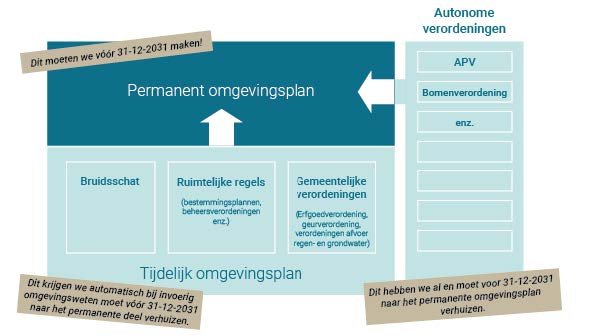
As a municipality, we have until December 31, 2031, to environmental plan the interim environmental plan into environmental plan single, comprehensive, municipality-wide environmental plan. The transition of regulations from the temporary section to the new section of the environmental plan on a location-by-location basis, so we are addressing this area by area and phase by phase. Where necessary, we will implement new policies regarding the physical living environment through a thematic amendment to the environmental plan.
How do we approach new spatial developments?
New spatial initiatives will soon have to be assessed against the (temporary) environmental plan. If the initiative is consistent with the (temporary) environmental plan, a permit can be issued immediately. Of course, the environmental permit must comply with legal requirements and, for example, our public participation policy.
We environmental plan new spatial initiatives that do not fit within the (temporary) environmental plan at the “Environmental Roundtable.” At the Environmental Roundtable, we discuss with all relevant advisors whether the initiative is desirable and feasible within the established frameworks and regulations. For initiatives that receive a positive recommendation, a planning procedure can be initiated. New spatial initiatives that do not fit within the (temporary) environmental plan be made possible under the Omgevingswet two ways, namely through:
- an environmental permit for an activity not covered by the environmental plan;
- an amendment to the (temporary) environmental plan.
In this document, we explain how our municipality evaluates these options and which procedural approach we apply to which types of land-use developments.
Activity outside the scope of the environmental plan
For new spatial developments that do not fit within the (temporary) environmental plan , we generally environmental plan an environmental permit procedure for an off-plan environmental planning activity (BOPA). The executive board the mayor and aldermen decides whether or not to grant the environmental permit.
Amendment to the environmental plan
New land-use developments that cannot meet the requirements of a BOPA may be environmental plan through an amendment to the environmental plan . An amendment may or may not be municipal council by the municipal council .
Prerequisites for amending the environmental plan
The following applies to the adoption of an amendment resolution:
- There must be a balanced allocation of functions across locations. The balanced allocation of functions across locations is the successor to the principle of sound spatial planning. In doing so, we apply a broader balancing of interests that encompasses the entire physical living environment. This means that we also take into account aspects such as health, safety, livability, and sustainability in the balancing of interests.
- The guidelines issued by the province and the national government, as set forth in the Gelderland Environmental Regulation and the Living Environment Quality Decree, must be complied with.
We expect applicants to provide a justification (including any relevant studies) demonstrating that the specified Requirements be met.
West Maas en Waal, November 24, 2023