Portfolio Control and Public Services

  • Control, contract management, and legitimacy
  • Finance and taxes
  • Mobility
    • road traffic legislation, transport facilities (including public transport)
    • municipal traffic and transport plan
    • charging stations for electric vehicles
    • ferry services
  • Land development and land matters
    • land development, leasing, renting and letting, purchase and sale of municipal property
  • Municipal real estate, accommodations, and facilities
    • municipal buildings, sports and community centers, and playgrounds
  • Spatial management
    • public green spaces, landscape policy, cemeteries, roads and streets, public lighting, and sewer systems
  • Waste policy
    • Waste disposal and waste processing
  • Water policy inside and outside the dikes
  • Climate adaptation
    • Water Plan 2020-2025
    • Regional Adaptation Program (RAS), implementation program for climate-proof WMW

Commissioning partnerships

  • Tax cooperation Rivierenland
  • AVRI

Contracting partnerships

  • Rivierenland Environmental Agency

Portfolio addition

The topics from the Spatial Planning portfolio concerning Ruivertweg in Dreumel and housing construction on Schoenmakersstraat in Boven-Leeuwen.

Replacement of portfolio by Alderman M.A.A. van den Boom-Witzel

Contact information

Additional functions

Not paid

  • Member of the Supervisory Board of EduCare in Nunspeet and surrounding area.

Paid

  • Member of the Supervisory Board of De Drieslag in Barneveld and surroundings.

Columns

You'd better prepare yourself, March 2025

Together with you, as residents, we want to make the municipality greener and less paved. Together with you, we can better prepare for periods that are too wet, too dry, or too hot.

Our municipality is experiencing more frequent and much wetter weather. But also more frequent and much drier weather. Finally, we will have to deal with periods of prolonged and extreme heat. In January 2025, the municipal council adopted our new Climate Plan. It sets out measures that we will implement over the next five years.

By taking these measures, we can better protect ourselves against extreme weather conditions. We have already taken important steps in this direction in recent years. Think of removing stones and restoring greenery together. A measure that reduces the strain on our sewer system when there is too much precipitation. But we want to take more measures.

Together with the water board, we are creating climate buffers for periods of drought. These are basins in which we store water. During a prolonged period of drought, we can drain the basins. Farmers in particular use this extra water for their crops. We hope this will prevent water rationing.

To combat prolonged periods of extreme heat, we are planting more greenery. The (additional) trees create more shade. They also cause water to evaporate, which cools the air. A green environment heats up much less quickly than a paved environment. As a result, the air temperature rises less quickly on hot days and the nights are cooler. That's why I'm so happy with the paving initiative for our residents.

Finally, we are taking measures for periods of heavy rainfall. Our villages are very paved and there is a relatively large difference in elevation. This causes rainwater to drain quickly via sidewalks and roads. That is why we are going to dig extra ditches and disconnect from the sewer system more often. We are also planting more greenery and trees for this purpose. This will keep our feet dry.

We make plans together with the water board and the province. But we would also like to do this with you, as a resident. We need you to help make the municipality greener and less paved. Together with you, we can better prepare for periods that are too wet, too dry, or too hot.

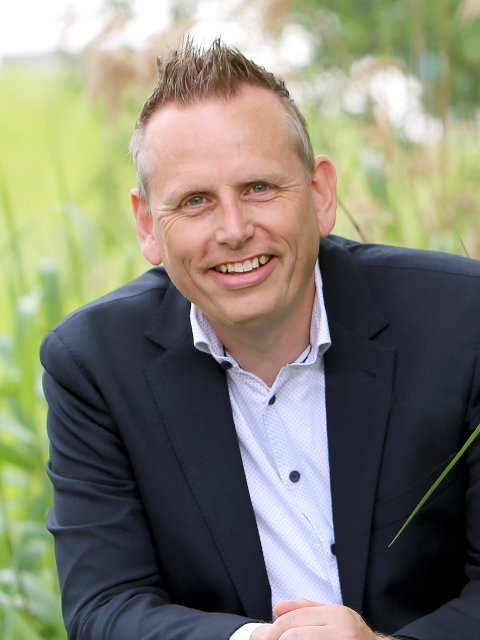
Evert Jan Slootweg
alderman

Quickly report an incident or stay informed, July 2025

As a municipality, we try to communicate with you, our residents, in many ways. For example, through messages in the Maas&Waler newspaper, on our website, via Facebook, and Instagram. We are also increasingly using apps. This allows us to communicate with you more quickly and in a more targeted manner.

Two examples. In Wamel, we are working on Dorpsstraat. We want to achieve several goals with the redevelopment. For example, we want to design the road in such a way that driving at a maximum speed of 30 km per hour is the norm. The road will then no longer encourage speeding. We also want to restore the 'village and historical character' of Dorpsstraat. The current sewer system will be replaced and a rainwater sewer will be installed. We hope that the work will be completed in November. We are using an app to keep residents of Dorpsstraat, as well as interested residents of Wamel, informed of the progress. Currently, more than 150 residents are using the app.

A second example is the BuitenBeter app. With the new BuitenBeter app, you can easily report issues such as loose paving stones, litter, or broken street lighting.  The app shows you whether a report has already been made by someone else. You can follow the report or see whether it is being processed or has been dealt with. You can also report issues anonymously via the BuitenBeter app. The BuitenBeter app replaces the MijnGemeente app. We have done this because the new app is easier to use, more user-friendly, and more modern. The app offers more options and a better connection to our system. This allows us to process your report more quickly.

Does this mean that we will only communicate with our residents via apps from now on? Absolutely not! We are still happy when you pick up the phone or send us an email to report something. We hope that by using these new technologies, we will be able to communicate with you more and more quickly. For example, to work together to keep West Maas en Waal clean and safe.

Evert Jan Slootweg
alderman

About transformer stations, August 2025

More and more people are demanding more electricity. For example, because they no longer have a gasoline-powered car, but an electric car. Or they have a heat pump and use little or no gas to heat their homes. So the demand for electricity has increased enormously. We expect this demand to increase even further.

But it's not just that people are demanding more power; they are also increasingly offering electricity. For example, because they have solar panels. And when I write 'people' or 'residents', I also mean companies and organizations. We as a municipality are also demanding more power, and we also generate electricity.

This poses enormous challenges for Liander, our network operator. The network operator installs cables and pipes and manages the energy network. They ensure that energy suppliers can supply power via their cables and pipes. This requires, among other things, transformer stations (transformer houses).

As the network becomes increasingly congested, more transformer stations are needed. It's actually just like on the road: it's getting busier.
In some places in the Netherlands, the electricity grid is so full that there isn't enough space for everyone. Anyone who needs extra power or applies for a new (heavier) connection sometimes has to wait a long time for it.

Over the next few years, 50,000 transformer stations will be added in the Netherlands. This means that 1 in 3 streets will be dug up. In our municipality, this will likely involve 100 additional transformer stations. As a municipality, we have decided to remain the owners of the land. We are granting the network operator a right of superficies.

The arrival of more transformer stations will certainly not please everyone. And the nuisance of dug-up streets is also annoying. But if this does not happen, there is a high risk of an electricity crisis and an increased chance of power outages.
The energy transition will only succeed if we are prepared to work together, be flexible, and listen to each other.

Councilor Evert Jan Slootweg