Wooden posts from the fourth century point to a Roman bridge
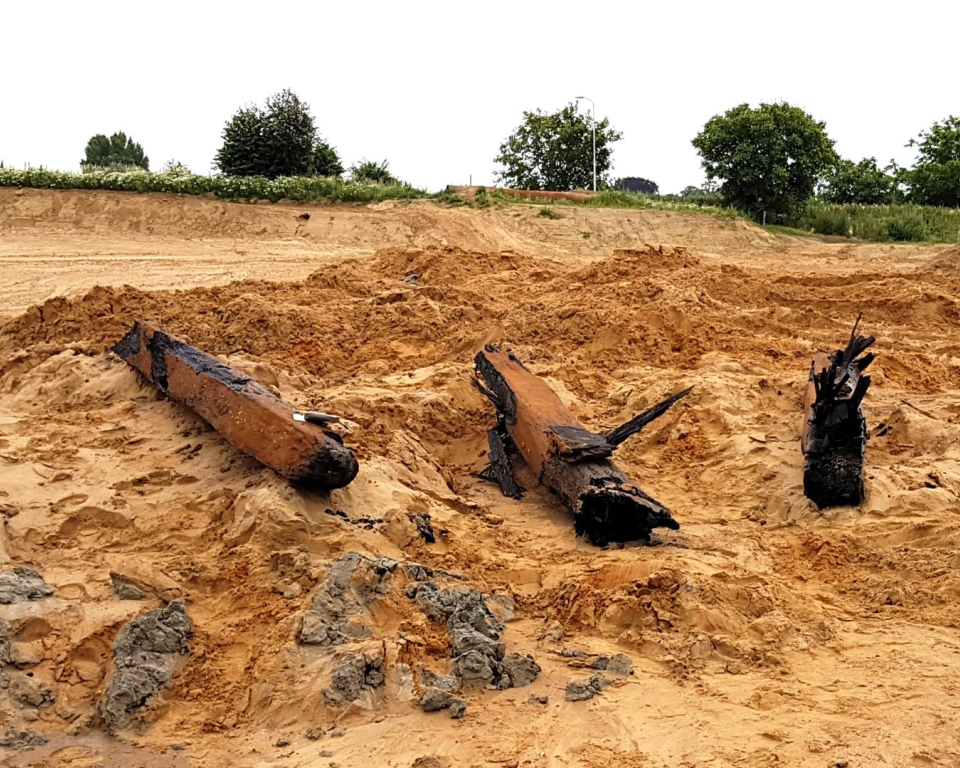
During a sand extraction project in an old riverbed of the Meuse, long, squared oak posts dating from the Late Roman period were discovered. The posts were found near the remains of a Roman road surface and at a location where a country road had already run in the early Middle Ages. Following an investigation commissioned by the province of Gelderland, archaeologists concluded that the posts likely formed a Roman bridge. This means that the Romans not only built roads to Maastricht and Nijmegen but also invested in a route along the Meuse and Waal rivers.
400,000 finds
At the “Over de Maas” sand extraction project near Dreumel , volunteers and archaeologists Dreumel uncovered 400,000 Roman and prehistoric artifacts since 2010, including a mammoth molar, a cannonball, tuff, spearheads, swords, boats, and pottery. It has now been revealed that four remarkable posts have also been recovered from the water. The longest post was found in 2018; it is 30–40 centimeters thick and was at least 11.5 meters long. This post was likely more than 13 meters long—the final, pointed section is still in the ground.
Dendrochronological analysis last year showed that the wood dates back to 363 A.D., that is, the Late Roman period. The province of Gelderland, which owns the archaeological finds, subsequently commissioned the firm Vos Archeo to investigate the significance of these posts.
The report on this was completed in May 2026. In it, archaeologist Wouter Vos concludes that the posts were part of a mooring post, a pier, or a bridge structure. The posts were straightened on the sides, and traces of woodworms indicate that the post was not completely submerged. “The position in the water, the considerable length of one of the posts, and clear parallels with similar finds near Cuijk suggest that we are likely dealing with a bridge structure here.”
Remains of a Roman road surface
That bridge would have spanned the stretch between Moordhuizen in Gelderland and Lith in Brabant. The theory that it was a Roman bridge is supported by its location and other findings. The piles were found at the point where the river was narrowest at that time. Remains of a Roman road surface had previously been found on the north bank. Furthermore, historians have long discussed an ancient road between Alem and Lith that dates back to before the Middle Ages.
In the late Roman period, there was sometimes so much water flowing through the Waal and Meuse rivers that the overland route from Nijmegen to the west became impassable. A detour via a crossing over the Meuse would make sense, with the road then continuing westward toward Alem.
Strategic Importance of Rivierenland
The presumed bridge reinforces the idea of a Roman overland route in Rivierenland.
Peter Drenth, Provincial Executive Member of Gelderland: “It appears that in the fourth century, the Romans invested not only in infrastructure in Cuijk and Maastricht but also in the Maas and Waal region. We can see that the riverine region remained strategically important from the Iron Age through the Middle Ages. These finds therefore tell us a great deal about Gelderland’s rich history.”
The recovered posts are severely deteriorated and likely cannot be preserved. It is probable that well-preserved remains are still present in the soil, especially on the north shore of the current lake. For this reason, the province of Gelderland will take additional archaeological research into account in future development projects.