Asian hornet
The Asian hornet has been present in our country for a few years now. This exotic insect species poses a threat to native bees and other insects. That is why it is important to be able to recognize this hornet and know what to do if you see one.
Why is the Asian hornet a problem?
The Asian hornet (Vespa velutina) is not native to the Netherlands or the rest of Europe. This hornet poses a threat to native bees and other insects. The Asian hornet preys on bees, bumblebees, and other insects. This has a negative impact on biodiversity and crop pollination. When the Asian hornet feels threatened, it can sting humans. A sting from the Asian hornet is slightly more painful and causes a more burning sensation than a regular wasp sting.
How can you identify the Asian hornet?
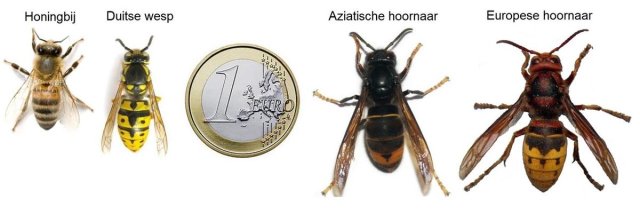
It is important to be able to identify the Asian hornet so that you can take immediate action. They are generally larger than native bees and wasps. Here are a few characteristics to look out for:
- Size: The queen can grow up to 3.5 cm in length. The workers are between 2 and 3 cm long.
- Color: They are dark, almost black, with a yellow or orange band on their abdomen.
- Face: The Asian hornet’s face is orange-colored, with a black ring around the eyes.
What should you do if you see an Asian hornet?
- Stay calm.
Try to remain calm and avoid making any sudden movements that might provoke the hornet. - Keep your distance.
Try to stay at a safe distance and avoid direct contact with the hornet. - Take photos.
If possible, take photos of the hornet so it can be identified. - Report a sighting via waarneming.nl.
This allows us to record nationwide reports and monitor the spread of the Asian hornet. - Got a sting?
Check the Red Cross website at to find out what you should do.
What are we doing to combat the Asian hornet?
We are taking various measures to prevent the spread of the virus. Here’s how we’re doing it:
- Providing information and guidance through our website.
- Responding to reports and personal observations.
- Removal of nests on municipal property.